
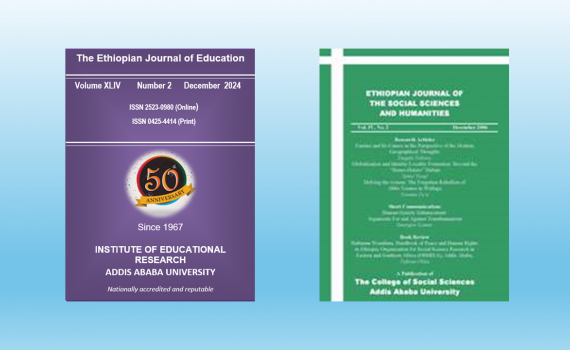
With support from EIFL, Addis Ababa University (AAU) implemented a year-long project to improve the visibility of and strengthen two no-fee (Diamond) open access journals. The journals are hosted by the national open-access publishing platform, Ethiopian Journals Online (EJOL), which is managed by AAU Library. The journals are:
- The Ethiopian Journal of Education (EJE). A pioneer in the education field, EJE has maintained a continuous presence since the 1960s, publishing articles that address key issues in teaching, learning, curriculum development, teacher education, and educational leadership, with a special emphasis on contexts relevant to Ethiopia and Africa. The journal has a significant impact on the research community in Africa by promoting locally grounded and evidence-based educational research that informs policy and practice.
- The Ethiopian Journal of the Social Sciences and Humanities (EJOSSAH) was launched in 2003 as the official journal of the College of Social Sciences at AAU. The journal publishes and promotes original research on Ethiopia and the Horn of Africa, with articles based on research using primary empirical data, including surveys, in-depth interviews, key informant interviews, focus group discussions, archives, newspapers, and information sourced from government and non-governmental organizations.
At the request of the AAU Research Office, three more Diamond OA journals were added during the course of the project: ZEDE Journal of Ethiopian Engineers and Architects, Ethiopian Journal of Behavioral Studies and the Ethiopian Journal of Development Research.
“At first, this request presented a significant challenge, as it risked stretching project resources beyond the planned capacity. However, rather than viewing it solely as a threat, the project team strategically transformed it into an opportunity,” said Melkamu Beyene, AAU Library Director.
The AAU project is one of 33 projects that have received grant support through a three-year project, ending in October 2026, to strengthen no-fee open access publishing in Africa, implemented by EIFL, AJOL (African Journals Online) and WACREN (the West and Central African Research and Education Network), with funding from Wellcome.
What has changed as a result of the project?
Editorial policies, author guidelines and journal websites have been revised and improved
Editorial policies and author guidelines of the EJE and the EJOSSAH were revised to ensure that they would meet international standards for open access journals, and specifically for indexing in international databases. A workflow document for publishing journals using EJOL was also produced.
EJOSSAH shared their experience of policy revision with editors from ZEDE Journal of Ethiopian Engineers and Architects, the Ethiopian Journal of Behavioral Studies and the Ethiopian Journal of Development Research, bringing the number of EJOL-hosted journals that have revised their policies to five.
“Revising the policies and publishing workflows of the two journals enabled us to highlight best practices in Diamond open access publishing for other local journals, while also empowering editorial teams to effectively utilize the online publishing workflow from manuscript submission to editorial management, peer review and publication,” said Melkamu Beyene.
The revised policies provide clear guidelines on editorial processes, peer review, ethical considerations in publishing scholarly journals, copyright and licensing, research data sharing and the use of Artificial Intelligence (AI). The revised policies are available via the journal profiles on the EJOL platform.
Journals also improved their online presence by fixing incomplete author affiliations and templates generating citations on article landing pages and included DOIs, licences and ORCIDs in the full text of articles.
Some of the journals did not have a complete digital archive uploaded on their websites. As a result of the project, seven volumes and 26 missing articles were digitized ensuring that all issues/volumes have a complete set of articles.
Knowledge and skills for use of OJS and EJOL have improved
Following the new publishing workflows document, the project team organized training for members of the editorial boards and peer-reviewers of the EJE and the EJOSSAH, ZEDE Journal of Ethiopian Engineers and Architects and the Ethiopian Journal of Behavioral Studies. The training focused on efficient use of the EJOL platform, which runs on Open Journal Systems (OJS), for managing journals and peer review. In all, 30 people took part in training sessions.
“The training has enhanced familiarity with the EJOL platform, its full range of features and has helped to streamline the editorial workflow and improve the overall efficiency of the peer review process,” said Girma Aweke, Assistant University Librarian, AAU Library.
To follow up the training, EJOL administrators at AAU library provided tailored guidance and support for journal editors and reviewers engaging with EJOL.
Visibility and discoverability of the journals has increased
Revision of policies enabled three journals, the EJE, the EJOSSAH and the Ethiopian Journal of Behavioral Studies, to apply - successfully - for indexing in the Directory of Open Access Journals (DOAJ), a free online database that lists peer-reviewed, open-access academic publications from across the globe. In addition to boosting visibility and discoverability of the three journals, DOAJ listing confirms their high editorial quality and trustworthiness, raising their global profile.
The project has also prepared the ZEDE Journal of Ethiopian Engineers and Architects and the Ethiopian Journal of Development Research to apply for indexing in DOAJ.
“The project gave us the opportunity to raise awareness within the broader AAU community about the role of Diamond open access in fostering equitable access to knowledge and encouraging bibliodiversity by eliminating the typical financial barriers for reading access and publishing articles in open access. Our plan is to further strengthen support for our Diamond open access journals by further raising awareness within the AAU management to understand the importance of Diamond open access,” said Getnet Lemma, AAU Library, EJOL Administrator.


