
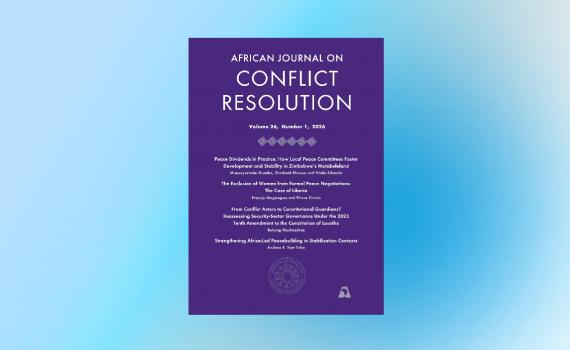
The African Journal on Conflict Resolution (AJCR) is published by the African Centre for the Constructive Resolution of Disputes (ACCORD) and has existed as a Diamond Open Access journal for the past 25 years, providing open access to multidisciplinary research on conflict resolution in Africa for scholars, practitioners, and policy-makers worldwide. The journal is accredited by the South African Department of Higher Education.
The AJCR is hosted by Khulisa, an open-access, scholarly journal hosting and publishing platform managed by the Academy of Science of South Africa (ASSAf). Khulisa hosts a number of scholarly journals, using Open Journal Systems (OJS) management and publishing software. The journal is indexed in the Directory of Open Access Journals (DOAJ), African Journals Online (AJOL), Sabinet, SciELO SA, and the Web of Science's Emerging Sources Citation Index (ESCI). The journal is on track to also be listed in the Social Sciences Citation Index (SSCI).
In September 2025 EIFL awarded ACCORD a grant for a 12-month project to help the AJCR to navigate a complex publishing landscape that is increasingly being influenced by large language models and artificial intelligence (AI); to build capacity of its editorial staff, and to sustain visibility through hosting on a public journal management system.
What changed as a result of the project?
The journal has enhanced plagiarism and AI-content detection processes and policies
AJCR has built a functioning plagiarism-detection process into its editorial workflow, using the web-based professional text-similarity detection tool, iThenticate. The use of iThenticate also deepened the editorial team’s understanding on issues related to the use of Artificial Intelligence in publishing.
The iThenticate training contributed to building capacity on issues related to the use of AI in publishing and on how to interpret results from the similarity checker. In this way, it contributed to enhancing the managing editor’s understanding of AI and plagiarism. The journal’s plagiarism policy has been updated, and a new AI policy governing acceptable use of AI tools in manuscript preparation has been introduced. “AJCR found it essential to clearly explain, within its author-facing policies, how similarity reports would be interpreted and used in editorial decision-making. This helped to maintain transparency and fairness, particularly in ensuring that non-native English speakers were not unfairly disadvantaged by standard phrasing flagged as similar,” said Dr Andrea Prah, the former Managing Editor.
“Together, the policies and the use of iThenticate have directly improved the quality and specificity of feedback given to authors, allowing reviewers to point precisely to where textual overlap occurs rather than raising plagiarism concerns in general terms,” she added.
Between 2 February and 31 August 2026, the AJCR received 148 new submissions, accepted 6, and declined 78 (59 desk rejections, 19 after review). The average time to make a first editorial decision was 30 days.
According to the new Managing Editor, Dr Patrick Mbugua: “The 30-day turnaround time reflects improvements in editorial workflows, including stronger manuscript screening processes and enhanced editorial capacity through targeted training. These measures enabled more efficient handling of submissions and faster communication of decisions to authors.
Both policies have been published on the journal’s website. “AJCR found it essential to clearly explain, within its author-facing policies, how similarity reports would be interpreted and used in editorial decision-making. This helped to maintain transparency and fairness, particularly in ensuring that non-native English speakers were not unfairly disadvantaged by standard phrasing flagged as similar,” said Dr Andrea Prah, the former Managing Editor.
“Together, the policies and the use of iThenticate have directly improved the quality and specificity of feedback given to authors, allowing reviewers to point precisely to where textual overlap occurs rather than raising plagiarism concerns in general terms,” she added.
Between 2 February and 31 August 2026, the AJCR received 148 new submissions, accepted 6, and declined 78 (59 desk rejections, 19 after review). The average time to make a first editorial decision was 30 days.
According to the new Managing Editor, Dr Patrick Mbugua: “The 30-day turnaround time reflects improvements in editorial workflows, including stronger manuscript screening processes and enhanced editorial capacity through targeted training. These measures enabled more efficient handling of submissions and faster communication of decisions to authors.
“Sustainable improvements in publication quality require both appropriate technological tools and clear supporting policies. Institutions should therefore allocate sufficient time and resources not only for software acquisition, but also for policy development, staff training, and stakeholder communication. Embedding these practices within routine editorial processes will help ensure that the benefits of the intervention continue beyond the grant period.”
Capacity of journal editors has been enhanced
Members of the ACCORD Research Unit whose tasks include editing and reviewing manuscripts submitted to AJCR took part in specialised 10-week copyediting training offered by the University of Cape Town. In addition to covering language usage, grammar, structure and style, the course provided practical guidance on effective ways of working and communicating with authors. “The training significantly strengthened my ability to review articles for content, coherence, structure, and technical accuracy. As a result, I am able to provide more concise, constructive, and substantive feedback to authors, contributing to improvements in the overall quality and clarity of the articles produced,” said one of the trainees.
AJCR is more visible and discoverable
In order to sustain the visibility of the journal, the project funding was used to cover the costs related to hosting the journal on a public online content management system, Khulisa. This platform is associated with the Academy of Science of South Africa and significantly adds to the integrity and credibility of the AJCR as a trusted academic source. As a result of the project, AJCR also included DOIs in article PDFs; each article's DOI now resolves correctly and is displayed as a live link.
Usage statistics recorded by OJS (used by Khulisa to host journals) indicate increased visibility and discoverability of the journal during the project period.
From 2 February 2026 to 31 August 2026, the AJCR recorded 14,149 total views, 61.5% more than in the same period in 2025, when the journal recorded 8,761 views.
From 2 February 2026 to 31 August 2026 there were also 13,463 full-text PDF downloads, confirming genuine, active readership of the journal's content.
Who sustains ongoing journal expenses?
Funding for the ongoing expenses of AJCR will continue to be maintained by ACCORD.
The project is one of 33 that have received grant support through a three-year project to strengthen Diamond open access publishing in Africa implemented by EIFL, AJOL (African Journals Online) and WACREN (the West and Central African Research and Education Network), with funding from Wellcome.
OA-AFRICA-GRANTEE


