
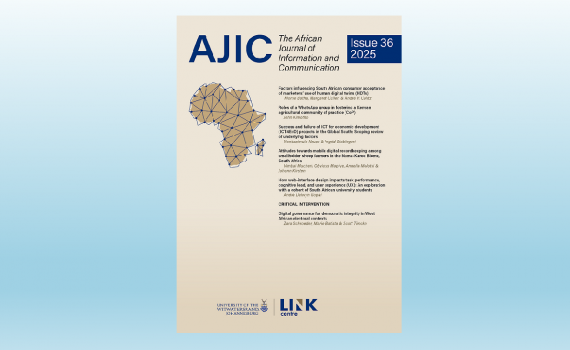
The African Journal of Information and Communication (AJIC) is an interdisciplinary, peer-reviewed, Diamond open access journal published by the LINK Centre at the University of the Witwatersrand (Wits) in Johannesburg, South Africa. AJIC's content focuses on the dimensions of digital, electronic and physical ecosystems that facilitate information, communication, innovation and transformation in African settings and in the broader Global South. AJIC is an important platform for emerging African scholars, as most articles published are by early-career researchers.
Launched by the Wits LINK Centre in 2000, the journal initially published as SAJIC – The Southern African Journal of Information and Communication. SAJIC published nine issues between 2000 and 2008, before transitioning to AJIC in 2010. As with AJIC, SAJIC was a peer-reviewed, no-fee open access academic journal accredited by the South African Department of Higher Education and Training (DHET).
“Over the past decade, AJIC has achieved several successes. We registered with the Crossref DOI registry to provide DOIs to all articles in both AJIC and SAJIC. AJIC was accepted into South Africa’s Scientific Electronic Library Online (SciELO) SA, which is the country’s leading open-access full-text journal database. The journal was also accepted into the globally recognised Directory of Open Access Journals. In addition, AJIC joined the Academy of Science of South Africa (ASSAf) Khulisa Journals platform, which uses the Open Journal Systems (OJS) journal management software,” says Chris Armstrong, AJIC’s Publishing Editor.
In 2024 EIFL awarded the Wits LINK Centre a grant for a project (October 2024 to January 2026) aimed at further strengthening AJIC through increased discoverability and visibility of its articles and authors, deepened subject-matter expertise on its Editorial Advisory Board and enhanced recognition of its peer reviewers.
What has changed as a result of the project?
Visibility and discoverability of articles and authors has increased
The grant enabled the AJIC team to set up and populate a new archive site for SAJIC articles, on the ASSAf Khulisa Journals OJS platform, so that all articles from both AJIC and SAJIC are now discoverable there. In addition, the team updated references and ORCID metadata for all SAJIC and AJIC articles on the Khulisa Journals platform, with the metadata also entered into each article’s DOI metadata deposit in the Crossref DOI registry.
The project also enabled AJIC to translate, into French and Portuguese, titles and abstracts for articles published from 2023-2025 . These translated elements will be added to AJIC’s site on the Khulisa platform once Khulisa’s OJS system is upgraded to include the functionality required for inclusion of translations of selected metadata fields.
“The ASSAf Khulisa Journals team’s willingness to set up, free-of-charge, a new SAJIC archive site on the Khulisa Journals platform was a result that exceeded expectations. This level of commitment and support deepened our already strong partnership with the platform.” – Chris Armstrong
Evidence of increased visibility and discoverability generated during the project includes the following:
- On AJIC’s site on the Khulisa platform, monthly article abstract viewing totals increased substantially, more than doubling from 3,506 views in October 2024 to 7,684 views in October 2025, and peaking at 12,117 in November 2025. In addition, AJIC’s monthly article file viewing totals on the Khulisa platform increased by 86%, from 1,990 views in October 2024 to 3,696 in October 2025.
- Also on the AJIC site, there was a notable increase in the annual volume of author submissions, from a total of 77 submissions in 2024 to 121 in 2025, representing a 57% increase.
- On the SAJIC archive site on the Khulisa platform, between June 2025 (when the archive went live), and December 2025 there were substantial increases month on month in views of SAJIC abstracts and article files.
Expertise on the AJIC Editorial Advisory Board has expanded
Also as part of the EIFL-funded project, AJIC conducted an audit of its Editorial Advisory Board members’ expertise in relation to the subject-matter areas most frequently covered in submissions received since 2023. Five areas were identified where increased Board expertise was needed, namely cybersecurity operations (applied knowledge in incident response, threat analysis, and digital resilience); computational linguistics and multilingual natural language processing (NLP) (African language technologies and linguistic artificial intelligence (AI) research); climate and sustainability innovation (intersections of digital transformation, environmental technologies, and sustainable development policy); social-capital analytics and collaboration networks (knowledge exchange and innovation ecosystems), and data ethics and digital rights (equity, inclusion, and governance issues in AI and data policy).
The project team developed a list of potential new Board members, and by the end of 2025 had appointed an expert in computational linguistics and multilingual NLP. To cover additional needs, five further members will be invited in 2026.
Peer reviewers are now recognized for their review activity
During the project, AJIC enrolled in the free version of Reviewer Credits, a cross-publisher platform to reward peer reviewers. The Reviewer Credits plug-in was activated on AJIC site on the Khulisa Journals platform, and all peer reviewers who contributed to Issues 29 to 35 (2022-2025) were issued credits. Going forward, from Issue 36 onwards, Reviewer Credits will automatically be sent to each issue’s peer reviewers.
To encourage more reviewers to create Reviewer Credits accounts, the project team created a guidance document detailing how AJIC uses the Reviewer Credits system, how reviewers can claim credits for past and future reviews, and how reviewers can link them to their ORCID profiles. The document was sent to all reviewers who contributed to Issues 29 to 35.
By the end of 2025, 118 peer reviews were registered in AJIC’s Reviewer Credits account, and 12 Reviewer Credits had been received and approved by reviewers.
“One key improved workflow resulting from the project is the ability AJIC now has to rapidly update, via the OJS plugin on the Khulisa Journals platform , any DOI metadata linked to a SAJIC or AJIC article published since 2000. Another important improved workflow is the automatic issuance of Review Credits, via another OJS plugin, to all peer reviewers for each issue.” – Chris Armstrong.
Who sustains ongoing journal expenses?
The journal is fully funded by the Wits LINK Centre, which covers the following: fees paid to AJIC’s internal Editorial team and external proofreader; annual fees to Crossref and Khulisa Journals, and an annual licence fee for desktop-publishing (DTP) software.
The Wits LINK Centre project is one of 33 that have received grant support through a three-year project to strengthen Diamond open access publishing in Africa implemented by EIFL, AJOL (African Journals Online) and WACREN (the West and Central African Research and Education Network), with funding from Wellcome. OA-AFRICA-GRANTEE
OA-AFRICA-GRANT


