
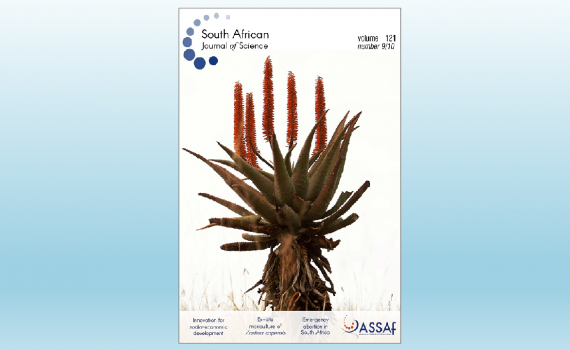
The South African Journal of Science is a bi-monthly Diamond open access journal that publishes high-quality, original, multidisciplinary research from Africa or on African-relevant issues for the benefit of scholars, educators, the general public and policymakers. It also provides a forum for discussion of news and developments in research and higher education. The journal is widely indexed in reputable and locally accredited global indexes and aims to promote the visibility and impact of South African and African research globally. It is published by the Academy of Science of South Africa (ASSAf).
A 12-month grant (October 2024 - September 2025) awarded by EIFL through the ‘Collaboration for sustainable open access publishing in Africa' project has helped to address three challenges affecting publication and quality of the journal: timeously securing peer review reports, meeting publication quality standards while minimising wait times to publication, and lack of capacity in author and reviewer pools.
“By subscribing to the paid version of Reviewer Credits – a tool that matches submissions to willing reviewers, thus helping to find peer reviewers, and recognizes and rewards peer reviewers – our objective was to assist our editors to secure peer reviewers and decrease the time for peer review. By engaging external copyediting assistance, our objective was to maintain publication standards in readability whilst decreasing the wait time for publication by publishing more articles in each issue. We aimed to directly build writing and peer review capacity, including an understanding of scholarly publishing, in emerging researchers through a hands-on in-person workshop, and thereby also indirectly grow our author and reviewer pools,” said Linda Fick, Managing Editor of The South African Journal of Science.
What has changed as a result of the project?
The journal has a more efficient peer reviewer selection process and an expanded reviewer database
The Premium version of the Reviewer Credits plugin was fully integrated into the journal’s management and publishing platform, Open Journal Systems (OJS), and was operational from April 2025. The editorial team underwent virtual training on the reviewer finder function, and a short manual on the tool was created and provided for reference.
“This project has contributed to several developments in the Reviewer Credits plugin for OJS, including enhancements to the reporting of review records to Reviewer Credits platform. These developments will potentially benefit other journals as well,” said Linda Fick.
Journal editors who used the tool to find reviewers have reported positive impacts through its use. “The tool has helped us to expand our existing reviewer database by incorporating reviewers found through the Reviewer Credits database,” said an editor.
In numbers, April to September 2025
- Overall, 86% of the editors who used Reviewer Credits reported that using it has made their editorial work easier
- 57% of editors that used Reviewer Credits reported a decrease in the time taken to find reviewers
- The average review time decreased from 58 days to 48 days for manuscript submissions assigned to editors who used Reviewer Credits
- The journal has added around 300 new reviewers to their database, found through Reviewer Credits or other means
Reviewers are recognized for their peer review activity
Usually peer-review is done on a voluntary basis, and the Reviewer Credits recognition feature addresses the under-recognitized contributions of peer reviewers in academic publishing. After completing a review, the reviewer is invited to export their review to their Reviewer Credits’ profile (or to sign up if they do not yet have a profile). Through the tool, the review activity of the reviewer is verified and certified. This way the peer-reviewer builds a profile that contributes to career growth.
From April to September 2025, 55 recognized reviewers exported their reviews to their Reviewer Credits profiles to verify and certify their review activity.
External copyediting service enhanced quality and ensured timeous publication of the journal
During the project period, the journal produced six regular issues of the journal; three themed issues; a special 120th anniversary issue of the journal, and three Discussion Series (a series of commentaries on topical issues). External copyediting support was contracted to manage the additional volume of content.
The external copyediting support allowed for the production of the special anniversary issue and Discussion Series to occur in parallel with the production of the regular issues, thereby facilitating timely publication of the Discussion Series without incurring any delays or backlogs in publication of the regular issues.
Because of the copyediting support received, 40 more articles and 100 more pages were published in the funding period than in the previous year. Despite the additional volume, the average time from acceptance to publication decreased by 20 days.
In numbers, during the project period -
- 179 articles published, 29% more than in the previous year
- 858 pages published, 14% more than in the previous year
- 87 days from acceptance of manuscripts to publication, 19 days (18%) fewer days than in the previous year
Better skilled authors and reviewers for the journal
ASSAf hosted an in-person writing and peer review workshop in July 2025, based on training facilitated and presented by members of the journal’s editorial team. Topics covered included academic writing, writing a journal article, journal selection and submission, publishing ethics, copyright, AI in publishing and reviewing skills. The goal of the workshop was for participants to produce a manuscript ready for submission to a journal within three months of completion of the workshop and to prepare participants to conduct a peer review of a manuscript.
From an overwhelming number of over 400 applicants, ASSAf selected a final number of 21 participants - all early career researchers (postgraduates or postdoctorates) affiliated with 13 higher education institutions from across South Africa and from a broad range of disciplines.
Participant feedback was positive: “Materials shared will go a long way in impacting my work in the academic space. I look forward to publishing two papers soon,” said a participant.
In numbers
- 81.8% of participants reported that the workshop had improved their knowledge and understanding of writing and peer reviewing an article
- Before the workshop, 60% of participants were not confident about writing or submitting an article, but after the workshop, most of the participants were very confident about both writing a journal article (56%) and submitting an article (72%)
- Before the workshop, 80% of participants were not confident about copyright; after the workshop, 94% were either confident (33%) or very confident (61%)
- Five participants submitted manuscripts produced during the workshop to various journals, and four either indicated their willingness to review or co-review articles or have participated in some form of peer review
Who sustains ongoing journal expenses?
The Journal is funded through its publisher, the Academy of Science of South Africa (ASSAf), which receives financial support from the South African Department of Science, Technology and Innovation.
Lessons learnt and recommendations for other journals and institutions supporting Diamond open access publishing
- Establishing good relationships with service providers facilitates good engagement and promotes development of products and services.
- Although training on the Reviewer Credits tool was provided to the editors at the time it was introduced, more active and continuous promotion is needed for adoption of new tools or services until they become routine.
- To optimize training outcomes, it is important that workshop participants receive long-term support, through online forums, mentorship and peer support groups. The South African Journal of Science continues to support emerging researchers, including the workshop participants, through their online monthly Journal Writing and Peer Review Forum, and host virtual workshops when capacity allows.
Further information about the South African Journal of Science.
The grant was awarded through the ‘Collaboration for sustainable open access publishing in Afriica' project (November 2023 to October 2026) that aims to strengthen no-fee open access publishing in Africa, implemented by EIFL, AJOL (African Journals Online) and WACREN (the West and Central African Research and Education Network), with funding from Wellcome.
OA-AFRICA-GRANTEE


