
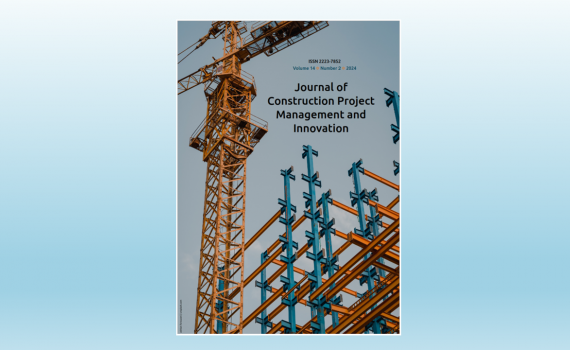
The Journal of Construction Project Management and Innovation (JCPMI) is a bi-annual Diamond Open Access scholarly journal dedicated to advancing knowledge, practice, and innovation within the construction and built environment disciplines. Established in 2010 and hosted by the University of Johannesburg, the journal provides an inclusive platform for disseminating high quality, peer-reviewed research without imposing publication or access fees.
In 2024 EIFL awarded the University of Johannesburg a grant for a project (September 2024 to September 2025) to improve the journal’s operational efficiency, elevate the quality of published research, and strengthen its regional and global standing. The project therefore sought to achieve three core objectives: (1) enhance community engagement through targeted webinars and workshops in South Africa, Ghana, Rwanda, and Nigeria, (2) build the capacities of emerging researchers in scholarly writing and peer review, and (3) support editorial excellence through improved workflows, professional editing, and strategic editorial planning.
What has changed as a result of the project?
The project has led to measurable improvements in the quality, visibility, and operational sustainability of the JCPMI.
There is stronger pool of authors, reviewers, and editorial assistants across South Africa, Ghana, Nigeria, and Rwanda
Community engagement increased significantly through the structured delivery of four hybrid workshops and targeted webinars across South Africa, Nigeria, Ghana, and Rwanda attended by over 750 participants. New academic linkages were formed through strengthened collaboration with partner universities, expanding the journal’s reviewer base and community of practice.
“Through these workshops and webinars the journal now benefits from a stronger pool of authors, reviewers, and editorial assistants across South Africa, Ghana, Nigeria, and Rwanda. The journal has already received 120 new manuscript submissions from workshop participants and 60 new reviewers were recruited. Evidence from participant feedback collected after the Nigeria and Ghana workshops indicates substantial gains in participants’ confidence in academic writing, peer-review processes, and ethical publishing standards. Many emerging researchers reported, through post-event evaluation, that they now better understand manuscript structuring, reviewer expectations, and how to engage constructively with editorial feedback skills that directly contribute to higher-quality submissions”, said Professor Clinton Aigbavboa, Editor of the JCPMI.
Improved workflows, access to professional copy-editing support, and clearer editorial guidelines
To strengthen the editorial team and support editorial processes, the JCPMI contracted professional copy editors and trained a corps of 10 editorial associates and assistants.
Training of editorial associates and assistants covered key components of the journal publishing workflow, including manuscript screening procedures, communication protocols with authors and reviewers, plagiarism detection, ethical publishing standards, and effective use of the Open Journal Systems (OJS) platform. The training programme combined practical demonstrations, supervised manuscript handling, and mentorship by senior members of the editorial team.
The training has resulted in more structured manuscript triage (initial screening) procedures, standardized communication templates, and strengthened reviewer recruitment. Manuscript triage (scope alignment, formatting compliance, and plagiarism checking) is now conducted by trained editorial associates within 1–5 days of article submission. Standardization of communication templates has ensured consistency and professionalism in correspondence with authors and reviewers. The expanded reviewer pool allows section editors to assign manuscripts more efficiently, improving response times and reducing reviewer fatigue.
These enhancements have reduced the average overall turnaround time from article submission to first decision to approximately 4–6 weeks, as opposed to approximately 8 - 10 weeks before the project.
“Editorial assistants trained and mentored under the project demonstrated enhanced proficiency in plagiarism screening, manuscript handling, and communication with authors, as observed through reduced turnaround times and improved consistency in editorial processes. These advancements have strengthened the journal’s internal capacity and reduced the burden on senior editors. Overall, the project has created a more efficient, well-supported editorial environment and promoted a community of skilled contributors, thereby significantly enhancing the journal’s long-term sustainability,” said Prof Aigbavboa.
Prof Aigbavboa shared lessons learned and recommendations arising out of the JCPMI’s mentorship programme during a webinar organized by EIFL in June 2026. See the slides and recording here.
The journal experienced a noticeable increase in manuscript submissions during the project implementation period. Prior to the project, annual submissions averaged approximately 100 manuscripts per year. During the project cycle the journal recorded a total of 162 manuscript submissions, reflecting a significant upward trend compared to previous years. This increase can be directly linked to the expanded community engagement activities, targeted workshops, and strengthened regional visibility of the journal across South Africa, Nigeria, Ghana, and Rwanda.
Who sustains ongoing journal expenses?
The journal’s ongoing editorial and operational expenses, such as copy editing, language editing, and remuneration of editorial assistants are funded through the Editor-in-Chief’s research funds. The University of Johannesburg Library remains responsible for maintaining and supporting the Open Journal Systems (OJS) platform, including hosting, technical support, and system upgrades. The University continues to underwrite core operational requirements such as system maintenance, digital infrastructure, and administrative support. Overall, the combined contributions from the University of Johannesburg and the Editor-in-Chief’s research funding will provide a stable and sustainable framework for managing the journal’s recurrent costs.
“The project improved operational sustainability. The editorial composition of the JCPMI now includes trained associates managing first level screening, systematic workflow tracking within OJS, clearer role allocation, and strengthened governance oversight, creating a more efficient, and internationally aligned publishing system,” said Prof Aigbavboa.
The University of Johannesburg project is one of 33 that have received grant support through a three-year project to strengthen Diamond open access publishing in Africa implemented by EIFL, AJOL (African Journals Online) and WACREN (the West and Central African Research and Education Network), with funding from Wellcome.
OA-AFRICA-GRANTEE


